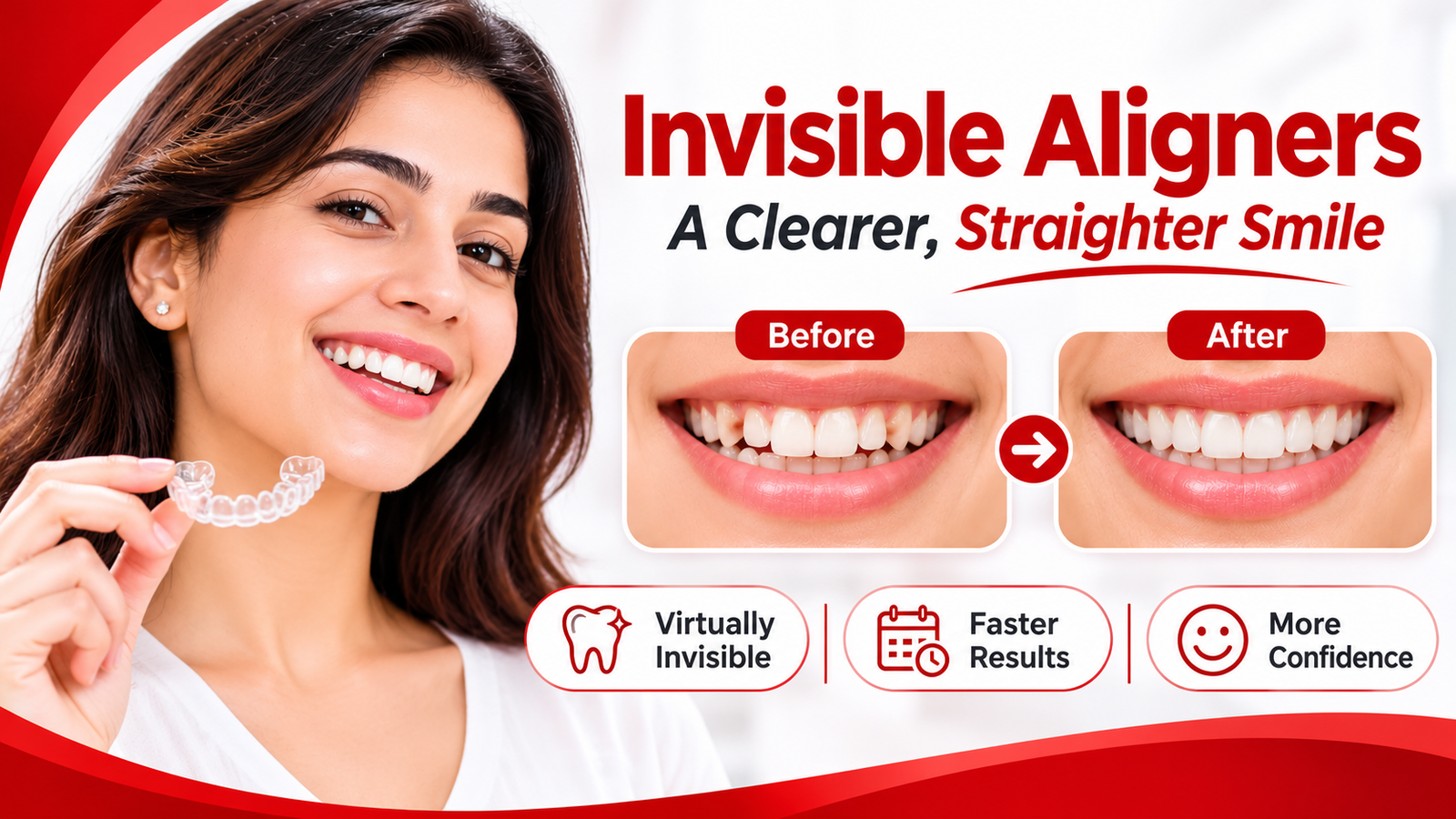
Straighter Teeth Without Braces: What Invisible Aligners Can and Can’t Fix
Meet Priya, a 28-year-old software professional who works near the Financial District. She avoids smiling in team photos because her lower front teeth overlap, and a small gap in her upper teeth bothers her every time she looks in the mirror. Metal braces feel too noticeable for client meetings. So she asks the question many people in Hyderabad are asking: can invisible aligners in Nanakramguda really fix this?
The short answer is yes, for most mild to moderate cases. This guide explains how, which problems aligners handle well, and where they have limits.
Quick Answer: Do Invisible Aligners Work for Crowding, Gaps and Bite Issues?
- Crowding: Yes, for mild to moderate cases.
- Gaps (spacing): Yes, aligners are very effective here.
- Bite problems: Often yes, especially overbite, underbite and crossbite of mild to moderate severity. Complex jaw-related issues may need other treatment.
- Average duration: Many cases take roughly 6 to 18 months, depending on complexity and how consistently the aligners are worn.
A dentist can only confirm suitability after a clinical examination and scans, so treat these as general guidelines.
What Are Invisible Aligners?
Invisible aligners are a series of clear, custom-made trays that sit snugly over your teeth. Each tray is designed to move your teeth a small distance, usually a fraction of a millimetre. You switch to the next tray every one to two weeks, and your teeth gradually shift into their planned positions.
Three features set them apart from traditional braces:
- Clear and discreet: The trays are made of transparent medical-grade plastic, so most people won’t notice them.
- Removable: You take them out to eat, drink and clean your teeth.
- Digitally planned: A 3D scan of your teeth lets your dentist map the full movement before treatment begins.
How Invisible Aligners Fix Crowding
Crowding happens when the jaw doesn’t have enough space for all the teeth. The teeth overlap, twist or sit behind one another, which makes brushing and flossing difficult. Over time, that raises the risk of plaque build-up, cavities and gum irritation.
Aligners create space in a few controlled ways:
- Gentle expansion: The arch is widened slightly to make room.
- Interproximal reduction (IPR): A very thin layer of enamel is polished between teeth where needed.
- Tooth-by-tooth movement: Each tray shifts specific teeth while others stay anchored.
For mild to moderate crowding, invisible aligners can give excellent results. Severe crowding sometimes needs extractions or fixed braces, and a proper assessment will tell you which path suits you.
How Invisible Aligners Close Gaps
Gaps between teeth, called diastema or spacing, are one of the problems aligners handle best. Gaps can come from smaller teeth, a larger jaw, gum conditions or habits like tongue thrusting.
Aligners close the space by moving teeth together in small stages. Your dentist may also use small tooth-coloured attachments (tiny bumps bonded to the teeth) to give the aligner extra grip.
If gaps keep returning, the cause may be habit-related, and your dentist can address that alongside the aligner plan.
Can Invisible Aligners Correct Bite Problems?
A bad bite, or malocclusion, isn’t just cosmetic. It can cause uneven tooth wear, jaw discomfort and difficulty chewing. Aligners can correct several common bite problems:
- Overbite: Upper front teeth overlap the lower teeth too much.
- Underbite: Lower teeth sit ahead of the upper teeth.
- Crossbite: Some upper teeth sit inside the lower teeth.
- Open bite: The front teeth don’t meet when the mouth is closed.
Results depend on severity. Mild to moderate bite issues respond well. Cases caused by the position of the jaw bones themselves may need a combined approach with other orthodontic appliances. An honest evaluation matters here, and it is what separates a good treatment plan from a rushed one.
Invisible Aligners vs Metal Braces: A Quick Comparison
- Appearance: Aligners are nearly invisible. Metal braces are clearly visible.
- Comfort: Aligners have smooth edges and no wires. Braces can irritate cheeks and gums.
- Eating: With aligners you remove them and eat normally. With braces, some foods are restricted.
- Cleaning: Aligners come off for brushing and flossing. Braces make cleaning harder.
- Complex cases: Braces handle severe cases well. Aligners are best for mild to moderate cases.
- Discipline needed: Aligners must be worn about 20 to 22 hours a day. Braces are fixed, so no compliance is required.
Who Is a Good Candidate?
You may be a good candidate for invisible aligners if you:
- Have mild to moderate crowding, spacing or bite concerns
- Have healthy gums and no untreated cavities
- Are an adult or an older teenager with all permanent teeth
- Can commit to wearing the trays for most of the day
- Want a discreet option for work or social settings
Aligners may not be ideal if you have severe jaw misalignment, significant gum disease or very complex tooth rotations. In those situations, your dentist will explain the better alternative.
What to Expect: The Treatment Journey
- Consultation and examination: Your dentist checks your teeth, gums and bite, and discusses your goals.
- Digital scan and plan: A 3D scan creates a step-by-step movement plan, and you can preview the expected result.
- Custom aligners: Your trays are made to fit your teeth precisely.
- Regular wear and check-ins: You change trays on schedule and visit periodically so your dentist can track progress.
- Retention: After treatment you wear retainers to keep your teeth in their new positions. Skipping this step is the most common reason teeth drift back.
Tips for Getting the Best Results
- Wear your aligners 20 to 22 hours daily and remove them only for meals and cleaning.
- Brush and floss before putting them back in, so food isn’t trapped against your teeth.
- Rinse the trays with cool water and clean them gently. Hot water can warp them.
- Drink only plain water while wearing them.
- Keep your case with you so the trays don’t get lost or wrapped in a napkin.
- Never skip check-ups, even if everything feels fine.
Why Choose Finedent Dental Clinic for Invisible Aligners in Nanakramguda?
Choosing the right dentist matters as much as choosing the right treatment. At Finedent dental clinic, treatment starts with a proper examination and a clear explanation of what aligners can realistically achieve for your teeth. You get a personalised plan, honest guidance on whether aligners are the right fit, and support through every stage of the process. For professionals and families in and around the Financial District, a clinic close to home makes regular check-ups far easier to keep up with.
Ready to find out whether invisible aligners in Nanakramguda can transform your smile? Book a consultation with Finedent at https://finedent.in/.
Frequently Asked Questions (FAQs)
Q1. Can invisible aligners fix crowded teeth?
Yes. Invisible aligners can correct mild to moderate crowding by gradually moving teeth into better alignment, sometimes with minor enamel polishing to create space. Severe crowding may need braces or other treatment.
Q2. Do invisible aligners work for gaps between teeth?
Yes. Closing gaps is one of the most predictable things aligners do, as the trays move teeth together in small, controlled stages.
Q3. Can invisible aligners correct an overbite or underbite?
Mild to moderate overbites, underbites and crossbites can often be corrected. Bite problems rooted in the jaw bones may need additional orthodontic treatment, which a dentist can assess.
Q4. How long does treatment with invisible aligners take?
Most cases take around 6 to 18 months, depending on how complex the problem is and how consistently you wear the trays. Minor corrections can be quicker.
Q5. Are invisible aligners painful?
You may feel mild pressure or tightness for a day or two when you start a new tray. This is normal and usually settles quickly. It is generally described as less irritating than wires and brackets.
Q6. How many hours a day should I wear my aligners?
About 20 to 22 hours a day. Remove them only to eat, drink anything other than water, and clean your teeth.
Q7. Can I eat and drink normally with invisible aligners?
Yes, because you take the trays out for meals. Brush your teeth before putting them back, and avoid drinking anything but plain water while wearing them.
Q8. Will people notice that I’m wearing invisible aligners?
Most people won’t. The trays are clear and fit closely to your teeth, though a slight shine or small attachments may be visible on close inspection.
Q9. Do I need a retainer after finishing treatment?
Yes. Retainers keep your teeth in their new positions. Without them, teeth can gradually shift back.
Q10. How do I know if invisible aligners are right for me?
Book an examination. A dentist will review your teeth, gums and bite, and tell you whether invisible aligners in Nanakramguda suit your case or whether another option would work better. You can reach Finedent at finedent.in.