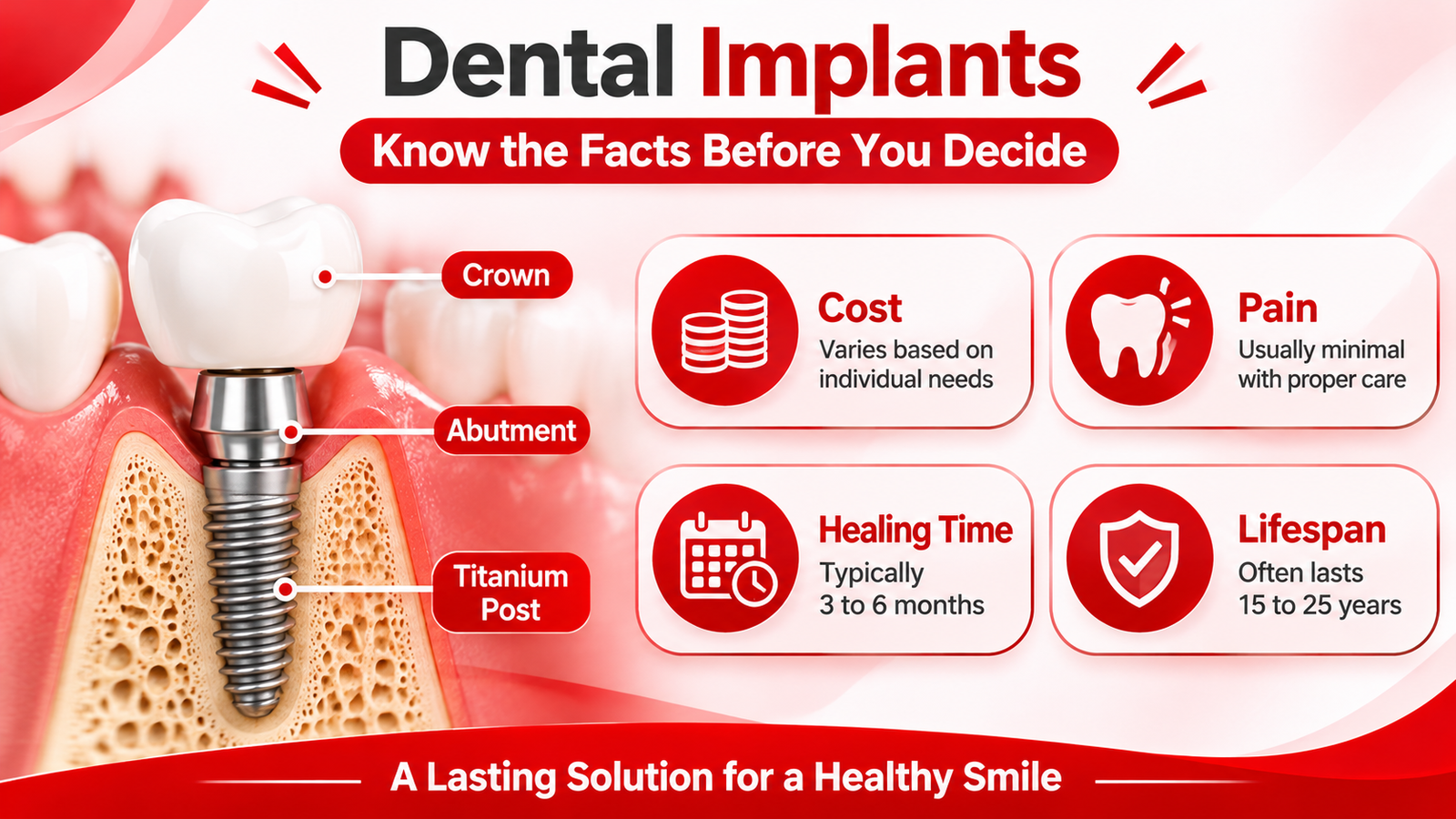
The Four Questions Every Patient Asks Before Getting Dental Implants
Almost everyone considering dental implants in Nanakramguda asks the same four things: How much will it cost? Will it hurt? How long until I can eat normally? And how long will it last?
This guide answers each one directly, so you can decide with clear expectations.
Quick Answer: Dental Implants at a Glance
- What they are: Titanium posts placed in the jawbone to replace missing tooth roots, topped with a custom crown.
- Pain level: Mild to moderate, managed with local anaesthesia and simple medication.
- Healing time: Gum healing takes a couple of weeks. The bone usually needs about 3 to 6 months to fuse with the implant.
- Lifespan: The implant post can last 15 to 25 years or longer with good care. Crowns may need replacing sooner.
- Cost: It varies by case, so a personalised quote follows your examination.
What Are Dental Implants?
Dental implants are artificial tooth roots made of biocompatible titanium. A dentist places the post into your jawbone, where it fuses with the bone over time. A connector called an abutment attaches the post to a custom-made crown that looks and works like a natural tooth.
Because the implant replaces the root, it helps preserve the jawbone. Bridges and dentures sit on top of the gums, while implants anchor into the bone. That is why many dentists consider implants the most complete replacement for a missing tooth.
Question 1: What Affects the Cost of Dental Implants?
There is no single price for dental implants, because several factors shape the final cost:
- Number of teeth being replaced: One implant costs less than several, though a full-arch plan may use fewer implants than teeth.
- Implant brand and material: Different systems carry different price points and warranties.
- Type of crown: Zirconia, porcelain-fused-to-metal and other materials vary in price.
- Bone and gum condition: If the bone is thin, a bone graft or sinus lift adds to the cost.
- Extraction or other pre-treatment: Removing a damaged tooth, treating infection or doing a deep cleaning may be needed first.
- Imaging and planning: Digital scans and 3D imaging help place the implant accurately.
- Dentist’s experience: A skilled implant dentist reduces the risk of complications.
- Follow-up care: Review visits after surgery are part of the process.
Be careful with very low quotes. Check what is included: the implant, abutment, crown, imaging and follow-up visits. A fair price is one you understand in full.
Question 2: Do Dental Implants Hurt?
Most patients are surprised by how manageable the procedure is.
- During surgery: Local anaesthesia numbs the area, so you feel pressure rather than pain.
- First 2 to 3 days: Mild to moderate soreness, swelling and minor bruising are common.
- After that: Discomfort usually settles quickly. Over-the-counter or prescribed pain relief is typically enough.
Tips to stay comfortable:
- Apply a cold compress on the cheek in the first 24 to 48 hours.
- Eat soft, cool foods for the first few days.
- Avoid smoking, which slows healing and raises the risk of failure.
- Follow your dentist’s medication instructions exactly.
Severe or worsening pain, heavy bleeding or fever isn’t normal. Call your dentist promptly if that happens.
Question 3: How Long Does Healing Take?
Healing happens in stages:
- Initial healing (1 to 2 weeks): The gum closes over the surgical site, and swelling goes down.
- Osseointegration (about 3 to 6 months): The bone grows around the implant and locks it in place. This is the critical phase.
- Abutment and crown placement: Once the implant is stable, the dentist attaches the abutment and takes impressions for the crown.
- Final crown fitting: The permanent crown is placed, and your bite is checked.
Healing time can be longer if you need a bone graft, have uncontrolled diabetes or smoke. In suitable cases, a dentist may place a temporary tooth the same day, but not everyone qualifies. Your examination and scans determine that.
Question 4: How Long Do Dental Implants Last?
With proper care, the titanium post can last decades, and many people keep their implants for life. The crown usually has a shorter life because it takes the daily chewing force, and it may need replacement after 10 to 20 years.
Factors that help your implant last:
- Good oral hygiene: Brush twice daily and clean between the teeth every day.
- Regular check-ups: Professional cleanings and X-rays catch problems early.
- No smoking: Smoking is one of the biggest risk factors for implant failure.
- Controlled health conditions: Well-managed diabetes and good gum health improve outcomes.
- Protecting against grinding: A night guard helps if you clench or grind your teeth.
The main threat to an implant is peri-implantitis, an infection of the gum and bone around it. It is largely preventable with consistent cleaning and regular reviews.
Who Is a Good Candidate for Dental Implants?
You may be a good candidate if you:
- Have one or more missing teeth
- Have healthy gums and enough jawbone, or are suitable for bone grafting
- Don’t have uncontrolled chronic conditions that affect healing
- Are committed to oral hygiene and follow-up visits
Age alone isn’t a barrier for adults. Teenagers whose jaws are still growing should wait until growth is complete.
What Happens at Your First Consultation?
- Examination: Your dentist checks your teeth, gums and overall oral health.
- Imaging: X-rays or 3D scans assess the bone and plan the placement.
- Discussion: You review options, timelines, costs and what to expect.
- Treatment plan: You receive a clear, step-by-step plan before anything starts.
Why Choose Finedent Dental Clinic for Dental Implants in Nanakramguda?
Implant treatment works best when planning is careful and the follow-up is consistent. At Finedent dental clinic, patients get a thorough examination, a clear explanation of the costs and timeline, and honest advice on whether dental implants are the right solution or whether another option suits them better. For people living or working around Nanakramguda and the Financial District, a clinic nearby also makes the review visits much easier to keep.
If you are considering dental implants in Nanakramguda, book a consultation at https://finedent.in/ and get a personalised plan.
Frequently Asked Questions (FAQs)
Q1. How much do dental implants cost in Nanakramguda?
The cost varies by case. It depends on the number of implants, the implant system, the crown material, any bone grafting needed and the pre-treatment required. A dentist can give an accurate quote after an examination and scans.
Q2. Are dental implants painful?
No, not during the procedure, because local anaesthesia numbs the area. Mild to moderate soreness for a few days afterwards is normal and can be managed with prescribed medication.
Q3. How long does it take to heal after getting dental implants?
Gums usually heal within one to two weeks. The bone typically takes about 3 to 6 months to fuse fully with the implant, though this can vary from person to person.
Q4. How long do dental implants last?
The implant post can last 15 to 25 years or longer, and often a lifetime with good care. The crown may need replacing after 10 to 20 years because of normal wear.
Q5. Can I get a tooth the same day as the implant?
In some suitable cases, a temporary tooth can be placed on the same day. Your dentist decides this based on bone quality, stability and your overall health.
Q6. Who should not get dental implants?
People with uncontrolled diabetes, active gum disease, heavy smoking habits or insufficient bone may need preparation first. Some of these conditions can be treated so you become a candidate later.
Q7. What is the success rate of dental implants?
Dental implants have a high success rate in healthy patients, commonly reported at well over 90 percent. Success depends on bone quality, oral hygiene, general health and not smoking.
Q8. Can I eat normally after getting dental implants?
You will eat soft foods for the first few days, then gradually return to normal. Once the final crown is fitted and healed, you can eat most foods comfortably.
Q9. Are dental implants better than dentures or bridges?
Implants preserve the jawbone and feel more like natural teeth, and a bridge doesn’t require the neighbouring teeth to be shaved down the way a bridge does. Dentures and bridges are usually quicker and cheaper, so the better choice depends on your case and budget.
Q10. How do I take care of dental implants?
Brush twice daily, clean between your teeth every day, avoid smoking and attend regular check-ups. Treat your implants like natural teeth, because the gums around them can still get infected.