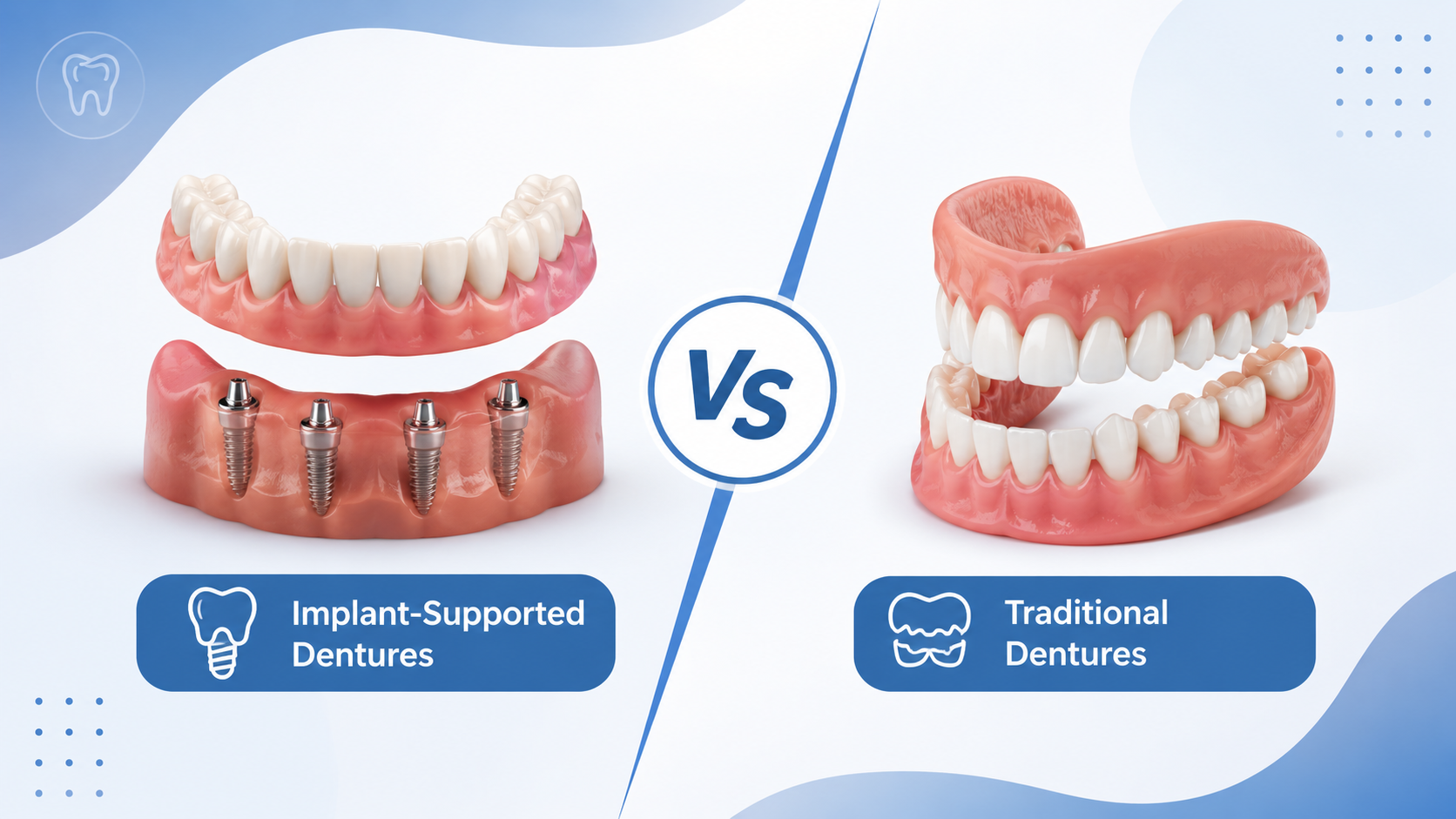
Introduction: Choosing the Right Dentures Can Change Your Life
Losing teeth — whether a few or all of them — is more than just a cosmetic concern. It affects the way you eat, speak, smile, and carry yourself every single day. The good news is that modern dentistry offers solutions that go far beyond the loose, uncomfortable dentures of the past.
Today, patients have a choice between traditional dentures and implant-supported dentures—and that choice matters more than most people realise. If you’re feeling overwhelmed trying to figure out which option is right for you, you’re not alone. At Finedent’s Dentures Clinic in Nanakramguda, we guide patients through this decision every day with honesty, expertise, and genuine care.
In this blog, we break down both options clearly so you can make an informed decision with confidence.
What Are Traditional Dentures?
Traditional dentures—also called conventional dentures—are removable prosthetic teeth that sit on top of the gums. They come in two main types:
Full Dentures: Replace an entire arch of missing teeth — either upper, lower, or both. They rely on suction, natural gum contours, and sometimes adhesive pastes to stay in place.
Partial Dentures: Used when some natural teeth remain. They clip onto existing teeth using metal clasps and fill in the gaps left by missing ones.
Traditional dentures have been around for centuries and are a well-established, accessible option for patients who need tooth replacement. They are generally more affordable upfront and require no surgery, making them a practical starting point for many people.
However, they come with limitations that become more apparent over time — and that’s where implant-supported dentures enter the picture.
What Are Implant-Supported Dentures?
Implant-supported dentures combine the functionality of dental implants with the coverage of a full denture. Instead of resting loosely on the gums, the denture is anchored to titanium implant posts that are surgically placed into the jawbone.
There are two common types:
Bar-Retained Dentures: A thin metal bar follows the curve of the jaw and attaches to two to five implants. The denture clips onto this bar for a secure fit.
Ball-Retained (Stud-Attachment) Dentures: Each implant has a ball-shaped connector that fits into a socket on the denture—similar to a snap-fit mechanism.
Both types offer far superior stability compared to traditional dentures, and at Finedent’s Dentures Clinic, we assess each patient individually to determine which design suits their jaw structure and lifestyle best.
Key Differences: Implant-Supported vs Traditional Dentures
Let’s compare both options across the factors that matter most to patients:
Stability and Comfort Traditional dentures can slip, click, or shift — especially while eating or speaking. This is one of the most common complaints patients bring to our Dentures Clinic. Implant-supported dentures, by contrast, are locked firmly in place. They don’t move, don’t require adhesives, and feel far more like natural teeth.
Bone Health This is a factor many patients don’t consider until it’s too late. When teeth are lost, the jawbone beneath begins to shrink — a process called bone resorption. Traditional dentures do nothing to stop this; in fact, the pressure they place on the gums can accelerate it. Implant-supported dentures stimulate the jawbone just like natural tooth roots do, preserving bone volume and facial structure over time.
Eating and Speaking With traditional dentures, patients often avoid certain foods—hard fruits, crusty bread, tough meats—out of fear of dislodging their dentures. Speaking can also be affected, particularly with words that involve the tongue pressing against the roof of the mouth. Implant-supported dentures restore near-normal biting force and speech clarity, allowing patients to eat what they want and speak with confidence.
Maintenance Traditional dentures are removed nightly for soaking and cleaning. Implant-supported dentures — particularly fixed versions — are cleaned more like natural teeth, with regular brushing and flossing around the implant sites. Both require routine dental check-ups, which our Dentures Clinic team will schedule for you.
Longevity Traditional dentures typically need to be replaced or relined every five to seven years as the gum and bone shape changes. Implant-supported dentures, with proper care, can last 15 to 20 years or longer—making them a strong long-term investment despite the higher initial cost.
Cost Traditional dentures are significantly less expensive upfront. Implant-supported dentures involve surgical placement of implants, which adds to the cost—but when you factor in the longevity, reduced need for replacements, and quality of life improvements, many patients find the value well worth it.
Who Is a Good Candidate for Each Option?
Traditional Dentures May Be Right For You If:
- You need an immediate, affordable tooth replacement solution
- You are not a candidate for surgery due to health conditions
- Your bone loss is extensive and implants are not currently feasible without bone grafting
- You are looking for a temporary solution while considering long-term options
Implant-Supported Dentures May Be Right For You If:
- You want a stable, long-lasting solution that feels natural
- You are in good general health and have adequate bone density
- You are frustrated with the instability or discomfort of traditional dentures
- You want to preserve your jawbone and maintain your facial structure long-term
At Finedent’s Dentures Clinic, we use digital X-rays and 3D imaging to assess your bone health and gum condition before making any recommendation. There is no pressure — only honest, personalised guidance based on what your mouth actually needs.
What Does the Treatment Process Look Like?
For Traditional Dentures: The process is relatively straightforward. Impressions of your gums are taken, a custom denture is fabricated in a dental lab, and fittings are done to ensure comfort and function. The entire process typically takes two to four weeks.
For Implant-Supported Dentures: The timeline is longer and involves multiple stages—implant placement, a healing period of three to six months for osseointegration (where the implant fuses with the bone), followed by attachment of the denture. While the process requires patience, the outcome is dramatically more stable and life-changing for most patients.
Both treatments are carried out with care and precision at our Dentures Clinic, with full support provided at every stage.
Finedent’s Recommendation: What’s Best for You?
Here’s the honest truth — there is no universally “better” option. The right choice depends entirely on your oral health, budget, lifestyle, and long-term goals.
What we always tell patients at Finedent is this: if your health and bone density allow for implants, implant-supported dentures offer a superior quality of life in the long run. But if traditional dentures are the right starting point for your situation, we will make sure they fit well, look natural, and serve you comfortably.
Our job is to give you a solution that works for your life — not a one-size-fits-all recommendation.
Conclusion: You Deserve Dentures That Work as Hard as You Do
Whether you choose traditional or implant-supported dentures, the goal is the same — a comfortable, functional, confident smile that lets you live your life without limitations. At Finedent Dental Clinic, Nanakramguda’s trusted Dentures Clinic, we bring experience, technology, and compassionate care to every patient who walks through our doors.
Don’t settle for dentures that slip, ache, or hold you back. You deserve better — and we’re here to help you get there.
📞 Book your denture consultation today at finedent.in and take the first step toward a smile that fits your life perfectly.
Frequently Asked Questions (FAQs)
Q1. Can I switch from traditional dentures to implant-supported dentures later?
Yes, in most cases you can. Your dentist will assess your current bone density and gum health to determine if you are a suitable candidate. Some patients may require a bone grafting procedure first if significant bone loss has already occurred.
Q2. Are implant-supported dentures painful to get?
The implant placement procedure is performed under local anaesthesia, so you won’t feel pain during the surgery. Some soreness and swelling in the days following the procedure is normal and manageable with prescribed medication. Most patients find the experience far more comfortable than they expected.
Q3. How do I care for my dentures to make them last longer?
For traditional dentures, remove and rinse them after eating, brush them daily with a soft brush, and soak them overnight in a denture-cleaning solution. For implant-supported dentures, brush around the implant sites twice daily, floss carefully, and attend regular check-ups at your Dentures Clinic to monitor implant health and denture fit.